Malware Classifier Backdoors
This academic study examined how poisoned training data affected malware classifiers, comparing attack success with the clean detection behaviour that still had to be preserved.
Academic research and report. Using and extending an existing backdoor-study implementation.
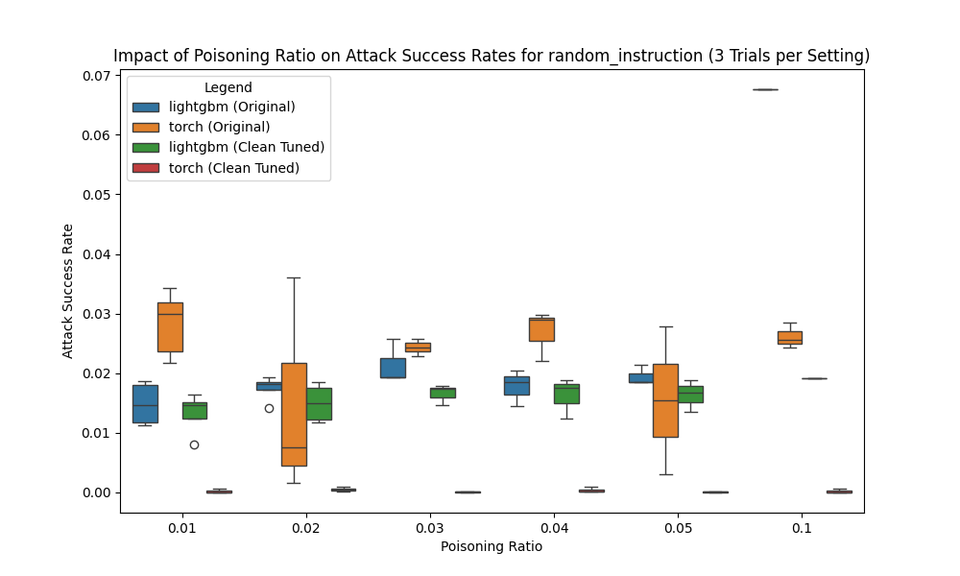
I worked on malware classification under poisoned training data, where the important comparison involved both whether a trigger changed the prediction and what happened to ordinary detection at the same time, with the clean metric kept beside the attack metric so a change in one could not hide the other.
The manuscript brought together experiments across model choices and poisoning conditions, with plots separating clean performance from attack behaviour and supporting material for the feature and backdoor comparisons.
The preserved work includes an external implementation fork alongside the report, though the numerical claims belong to those recorded experiments and should be read with the dataset and attack assumptions they used.
The catalogue date follows the first preserved commit on 17 February 2025.
Outcome
An academic manuscript with experiment figures and classifier comparisons. The entry describes the study without claiming a first-of-its-kind result or general immunity to backdoors.